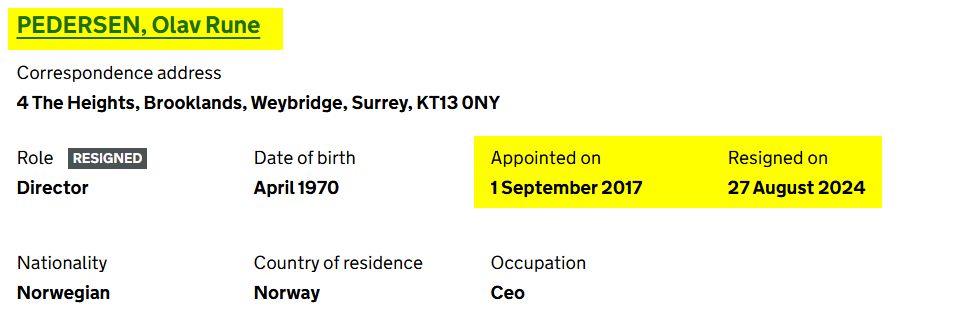
Rune Olav Pedersen as Director of PGS Exploration (UK) Limited and CEO of PGS ASA Initiated Whistleblower Retaliation Using the Courts of Thailand
Board Representation: Arvid Trolle, the Co-Founder and Co-Portfolio Manager of Njord Partners, serves directly as a Board Director at GeoQuip Marine. Njord Partners conducts leadership due diligence through a specialized lens, focusing heavily on a candidate’s “turnaround and transformation” capabilities. Because Njord primarily operates as a special-situations and distressed-debt investor, their screening framework for C-suite positions (CEOs, CFOs, Chief Restructuring Officers) is vastly different from traditional growth-oriented private equity firms.
Geoquip Marine, a provider of geotechnical services to the global offshore energy sector and Njord Partners portfolio company announced on 27 September 2024 the appointment of Rune Olav Pedersen as CEO, effective January 1, 2025. Pedersen had been the CEO of PGS ASA from 1 September 2017 through the completion of PGS ASA merger with TGS ASA 1 July 2024. From 2010 until September 2017, Pedersen served as PGS General Counsel and Legal Compliance. This is when the Whistleblower first became aware of Pedersen as a lawyer entrusted to ensure adherence to the laws and policies guiding business decisions.
Was Arvid Trolle, through his responsibility of due diligence to investors, aware that Pedersen, his co-horts or legal representatives failed to appear two times within the criminal courts of the Kingdom of Thailand for the prosecution that they initiated for Criminal Defamation against a proclaimed Whistleblower? The Kingdom of Thailand case was finally dismissed in May 2024 whilst merger negotiations between PGS ASA and TGS ASA were ongoing and only a few months before Pedersen was selected to be CEO of GeoQuip Marine.
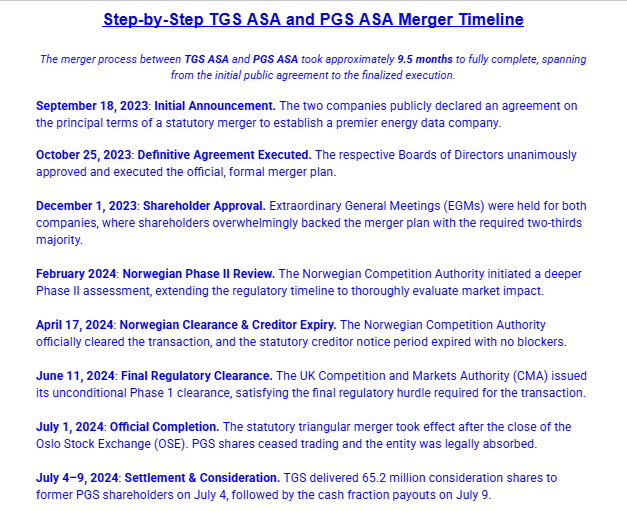
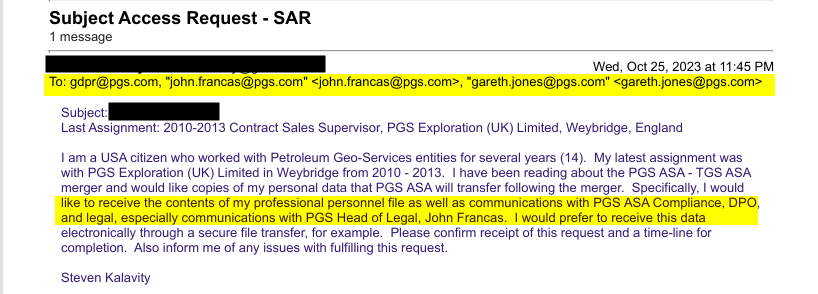
The merger discussions were of great interest to the Whistleblower. The merger of two Norwegian companies, TGS ASA (TGS) and PGS ASA (PGS) published initiation was on 18 September 2023. On 25 October 2023, a Definitive Agreement was executed. On 30 October 2023, the Whistleblower submitted a subject access request (SAR) citing the General Data Protection Regulation (GDPR) to PGS on 25 October 2023 so that all of the Whistleblower’s personal data, especially the personnel file, would be preserved (by TGS ASA) following the merger completion.
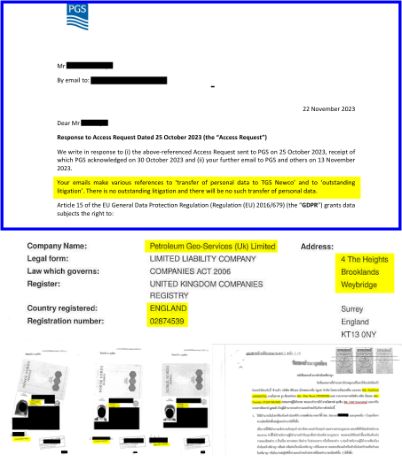
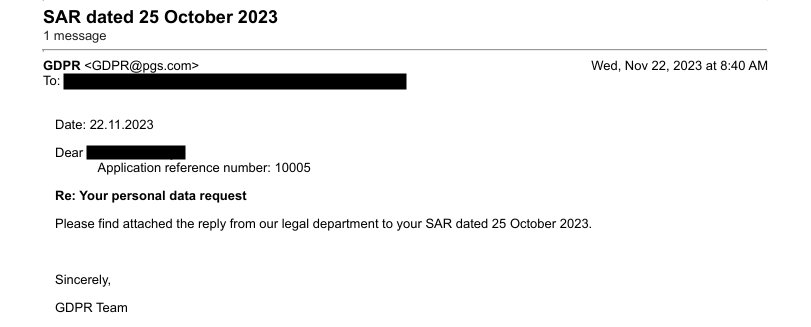
A response from PGS was received 22 November 2023.
PGS has continually lied in official correspondence regarding legal compliance to the law of England. On 22 November, while merger discussions were ongoing, PGS related that there was no out-standing litigation. On 31 December 2023, the Whistleblower was arrested and imprisoned for 4 days in Thailand based the litigation sponsored by PGS Exploration (UK) Limited directors: Rune Olav Pedersen (PGS ASA CEO), Gottfred Langseth (PGS ASA CFO) and Christin Steen-Nilsen (PGS ASA SVP) which PGS fraudulently report to the public does not exist. TGS ASA was provided with substantial data and knew about the Thailand litigation. TGS ASA participated in defrauding the Whistleblower, investors and stakeholders.
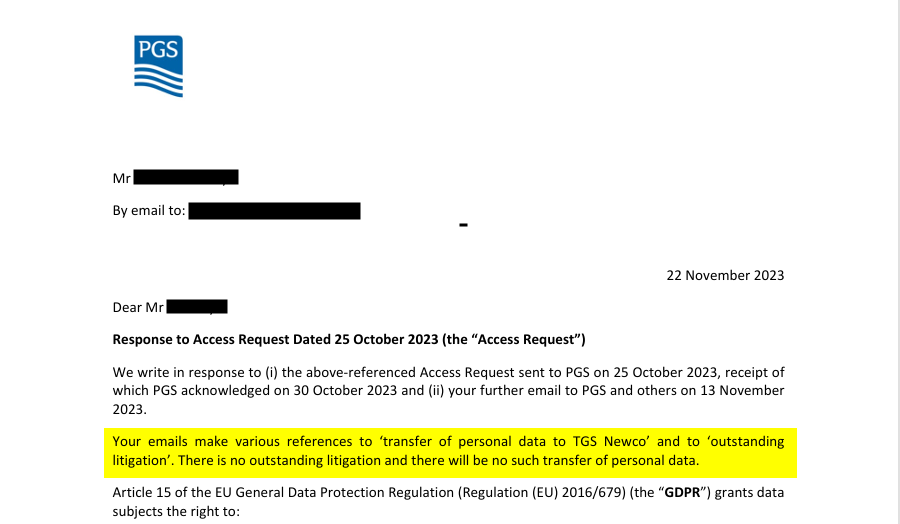
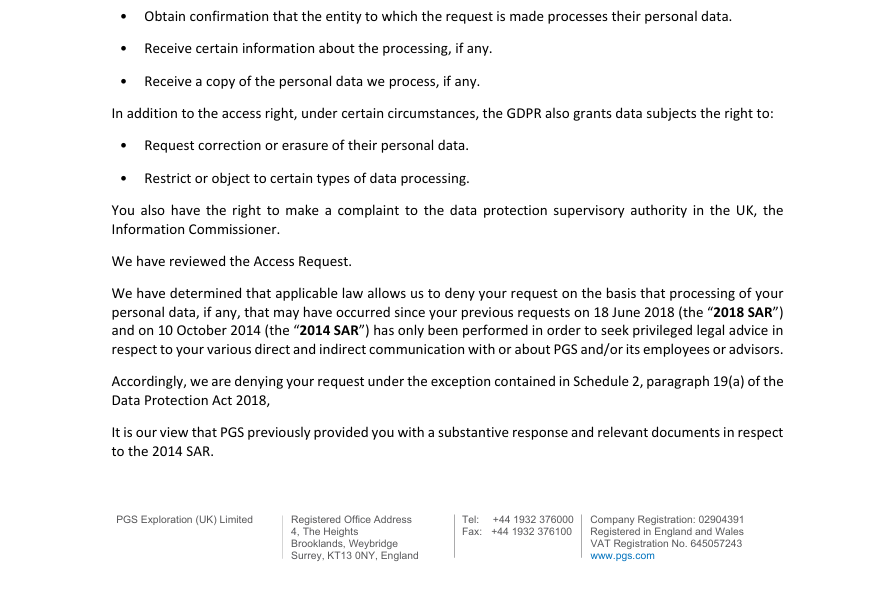
PGS refers to the Termination Settlement Agreement as a Legal Instrument.
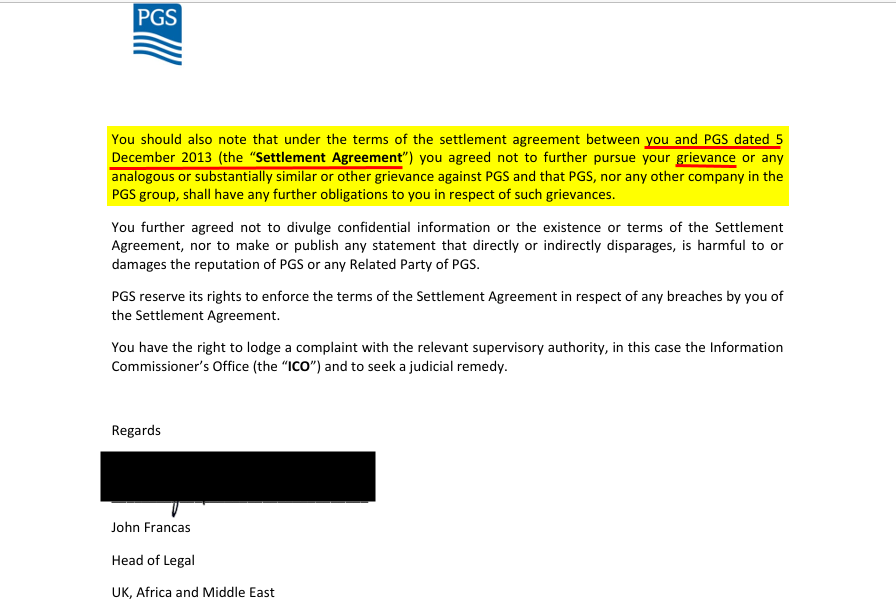
On 31 December 2023, the Whistleblower was arrested upon entry into Thailand. This means that PGS ASA, through henchman Francas, had lied to the Whistleblower AGAIN. There was, in fact, outstanding litigation ongoing in the form of an international arrest warrant that tracked and stalked the travels of the Whistleblower. The Whistleblower was detained in a Thailand prison for four days and had to travel from the USA to Thailand two times to attend Thailand Criminal Court proceedings in March 2024 and then again in May 2024. PGS Exploration (UK) Limited legal representatives failed to appear and the case was dismissed following the second proceeding. It should be noted that the arrest in Thailand, detention in Thai prison, and subsequent appearance at two hearings in Thailand Criminal Court all happened within the time-frame of the TGS – PGS merger which was initiated in September 2023 and finalized in July 2024.
The Thailand criminal defamation lawsuit was sponsored by PGS Exploration (UK) Limited directors Rune Olav Pedersen (PGS CEO), Gottfred Langseth (PGS CFO) and Christin Steen-Nilsen (PGS SVP). Normal legal disclosure and fiduciary due diligence would have required that both PGS and TGS board of directors be aware of such international criminal litigation that was ongoing. And Pedersen should have honestly made decision makers at Njord Partners aware of such litigation as a condition of appointing Pedersen to the position of Njord Partners portfolio company, GeoQuip Marine. It has been clear that PGS and their co-conspirators have tried to conceal and obstruct the Whistleblower’s allegations of board and executive misconduct. PGS Exploration (UK) Limited is an English company. The contract of employment between PGS Exploration (UK) Limited and the employee and the subsequent termination settlement contract are both governed by the law of England.
The Thailand litigation against the US citizen and former Tier 2 employee of PGS Exploration (UK) Limited was formally initiated in September 2018. This litigation was the acceleration of the illegal Whistleblower retaliation which began before the Whistleblower’s termination from employment. The Whistleblower had published online allegations that he was the target of a conspiracy to pervert the course of justice and defraud the Whistleblower to conceal and bury evidence of executive and lawyer civil and criminal malfeasance. The Whistleblower had for some time believed that the termination settlement contract was fraudulent and thus unenforceable. It was constructed by forged personnel records created to form a false and defamatory justification for termination. These records deceived UK Immigration and served to illegally blacklist the Whistleblower from industry employment. The issues of PGS processing false personnel records and projecting the termination settlement contract as a legally viable instrument were the topic of most all of the Whistleblower’s online publications. PGS has never taken any action for breach of contract through the law and courts of England.
Both the original contract of employment and the termination settlement contract contained Confidentiality terms and conditions that forbid parties from broadcasting or publishing content that disparaged PGS, its agents, stakeholders or customers. The PGS Exploration (UK) Limited prosecuted their case against the Whistleblower exploiting Thailand’s notoriously strict criminal defamation laws to silence the Whistleblower from revealing the conspirators corruption. The ltigation against the Whistleblower exploiting Thailand law and justice system peverted the course of justice (a crime under the law of England) and bypassed the law and courts of England. The Whistleblower had always wanted to adjudicate his allegations through the English justice system. English justice would have been a disaster for the Conspirators.
If the termination settlement contract between the Whistleblower and PGS were a legal instrument, PGS and its co-conspirators would not have spent shareholder money and time to litigate in Thailand. PGS and its co-conspirators were intent on escaping justice by the law and courts of England (and the USA). The Public Interest Disclosure Act (PIDA) is supposed to protect whistleblower’s. Termination settlement contracts that are formed through fraud and prevent whistleblowing through the inclusion of “gagging clauses” are illegal. (Such “gagging clauses” are also illegal under Norway’s Working Environment Act (WEA) that Norwegian executives are entrusted to uphold.)
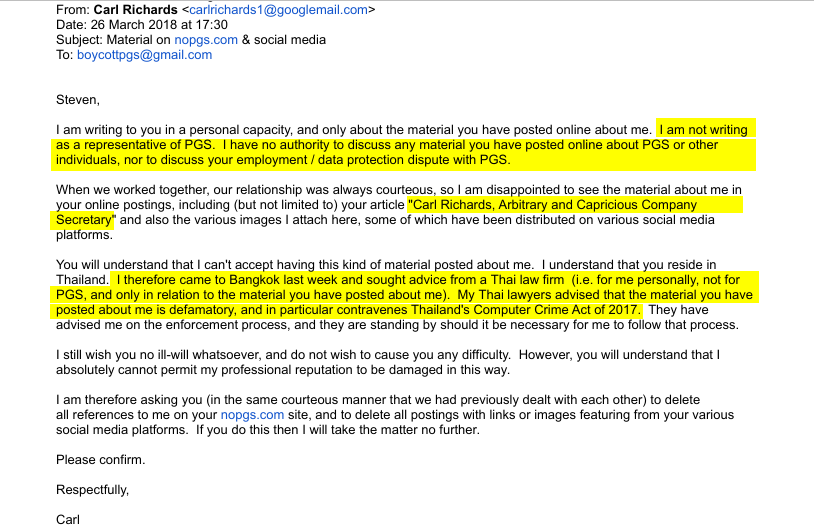
Following several online publications of protected disclosure of censurable acts (protected whistleblowing under the law of England and Norway), the Whistleblower received a threatening email sent to his website contact email. The email was sent from a private gmail account from a person purporting to be the Head of Legal and acting Secretary of PGS Exploration (UK) Limited, Carl Richards, which means that Carl Richards, licensed in the practice of English law, has a legal and fiduciary responsibility to ensure that actions approved by the Norwegian parent company comport to the law of England. Richards’ threats subvert both the law and his office as Secretary. Richards’ entrusted appointed duty and responsibility would be to act on any publications that breached the terms and conditions of the termination settlement contract through the law of England that is incribed within the Clauses of the termination settlement contract and not bypass the law of England..
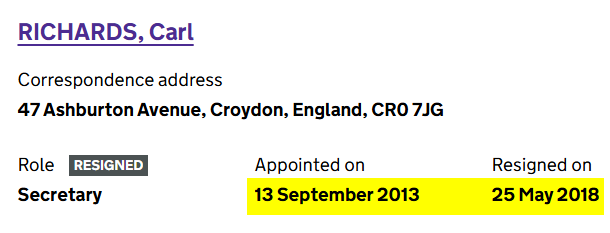
The email threatening criminal prosecution in Thailand was delivered through a private email account and not from an official @pgs.com account (which I would have immediately recognized as true and authentic as I interacted with Richards frequently by email while employed by PGS Exploration (UK) Limited. The email states that “Richards” is not representing PGS Exploration (UK) Limited (or PGS) but in a personal capacity?
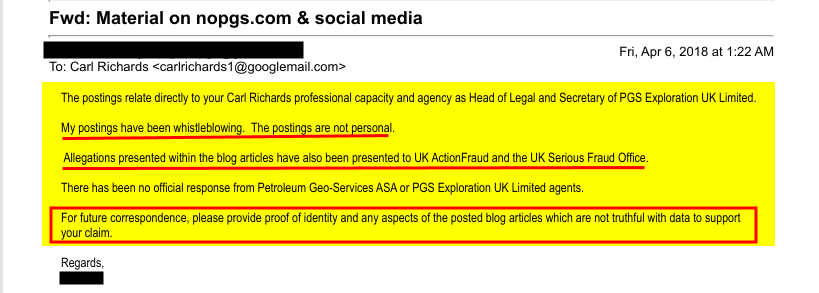
The Whistleblower’s response:
Similarly, Pedersen, was a director for PGS Exploration (UK) Limited and CEO of PGS. Pedersen was also the former General Counsel for PGS. Pedersen is.licensed in the practice of Norwegian law Pedersen has a legal and fiduciary responsibility to ensure that actions approved by the Norwegian parent company comport to the law of Norway as well as the law of England through the guidance of the Secretary (Richards) to ensure that PGS Exploration (UK) Limited decisions also comport to the law of England. This is the explicit role of a Company Secretary! Whistleblower retaliation is illegal under both the law of England and the law of Norway, as are fraudulent termination settlement contracts employed as a weapon for the illegal retaliation/
Richards’ never responded to the Whistleblower email response and confirmed his identity or addressed the simple queries. Under English law, defamation is a civil wrong (a tort) that occurs when a false statement is published to a third party and causes, or is likely to cause, serious harm to a person’s or company’s reputation. Disparagement appears as a restrictive covenant in employment contracts or settlement agreements. There is no independent “tort of disparagement,” in English law. Under the law of England, the time limits to bring claims are governed by the Limitation Act 1980. A defamation claim has a strict 1-year time limit, whereas a breach of contract claim gives you 6 to 12 years from the date of the breach. Richards never related what was untrue within the online published articles.
The first published public disclosures which could have been cited as a breach of contract (if it were not protected disclosure) was in September 2015. The Whistleblower’s belief is that Richards and PGS both know that the disclosures were whistleblowing and the termination settlement contract was fraudulent and built on forged personnel records. Any actions by PGS using the English legal system would have revealed the integrity of PGS processes and records and identified the perpetrators of civil and criminal violations of English law (as well as Norway law and USA law).
Because Richards never provided identity information to the Whistleblower, they did not take the unverified email threats completely serious as a legal matter. The Whistlebloer had submitted many subject access requests’ (PGS, Watson Farley & Williams, Philip Landau, LZW Solicitors) and was always required to confirm identity through passport photo and other. The Whistleblower ceased publications for a time but ignored the unverified Carl Richards threats. However, the Whistleblower received an email from a person purporting to be Richards’ Thai lawyer.
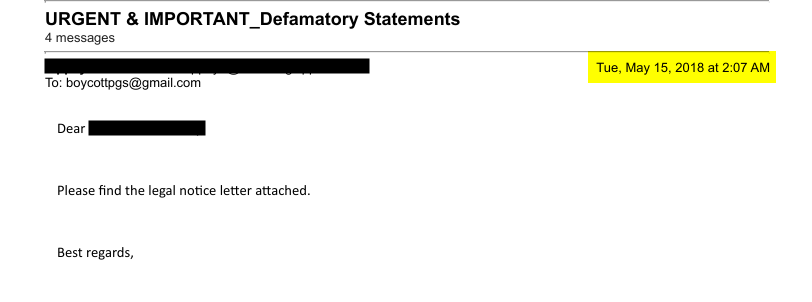
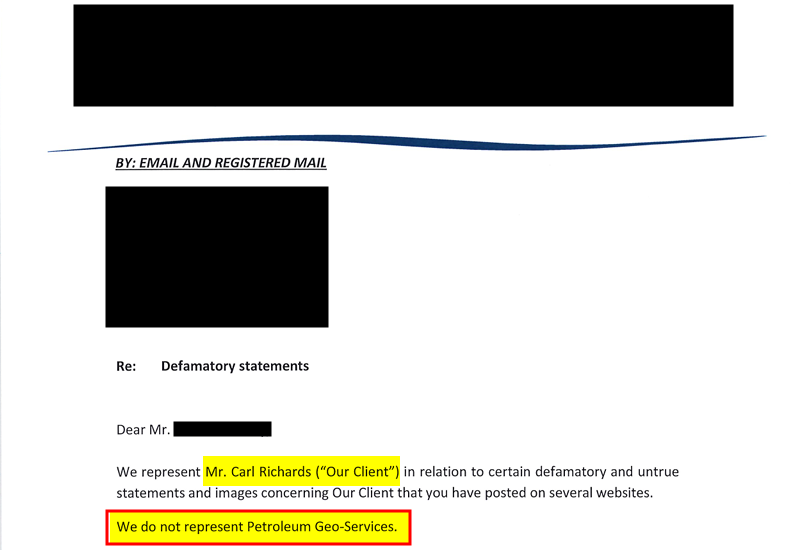
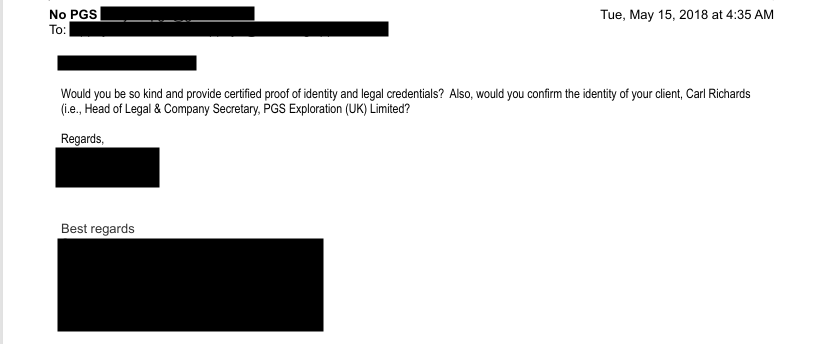
The Whistleblower had never provided Richards with his personal data, such as where the Whistleblower was living in Thailand. Further, acting as an individual and not as a Company Secretary, how would Richards legally have the Whistleblower’s address information in Thailand? Richards has no legal right to that information. PGS is a data controller but had not been provided current information. At the time of this email (15 May 2018), the Whistleblower had submitted an SAR to the legal firm that represented PGS Exploration (UK) Limited on matters of English employment law, Watson Farley & Williams. The Whistleblower had published allegations that Watson Farley & Williams conspired to form the forged documents which supported the fraudulent termination settlement contract.
Watson Farley and Williams (London) had also advised on the Whistleblower and dependent family members visas who also lived in England with the Tier 2 sponsored USA citizen worker. However, Thai passports were processed for the spouse and dependent minor children. Watson Farley & Wulliams also have a branch in Bangkok Thailand.
20180515_0435
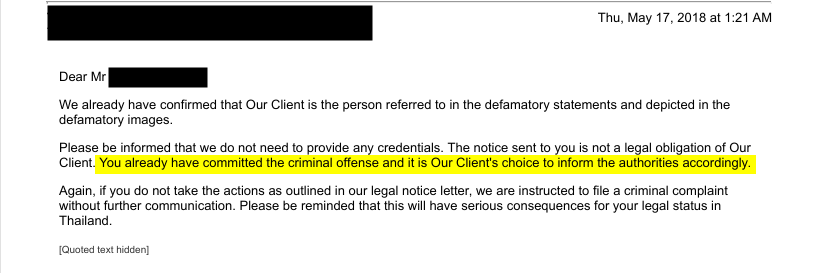
20180517_0121
20180517_0316
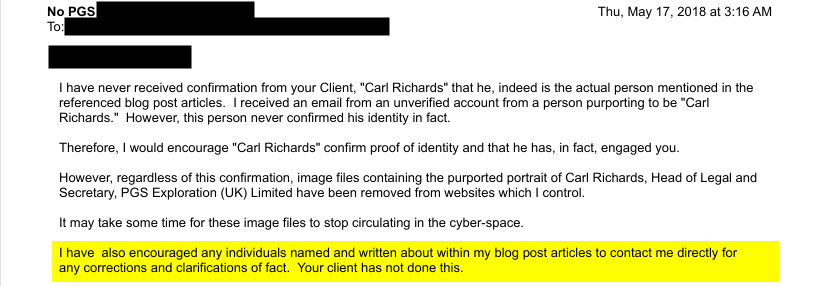
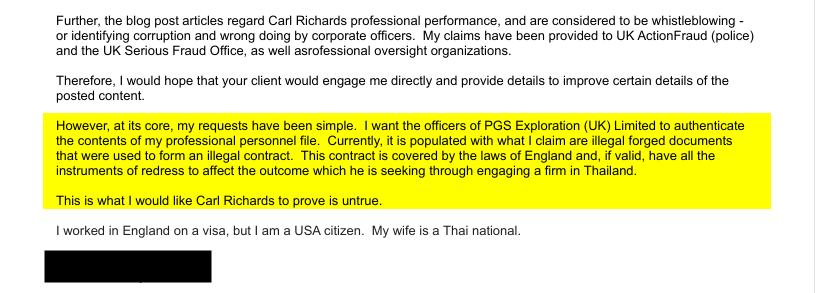
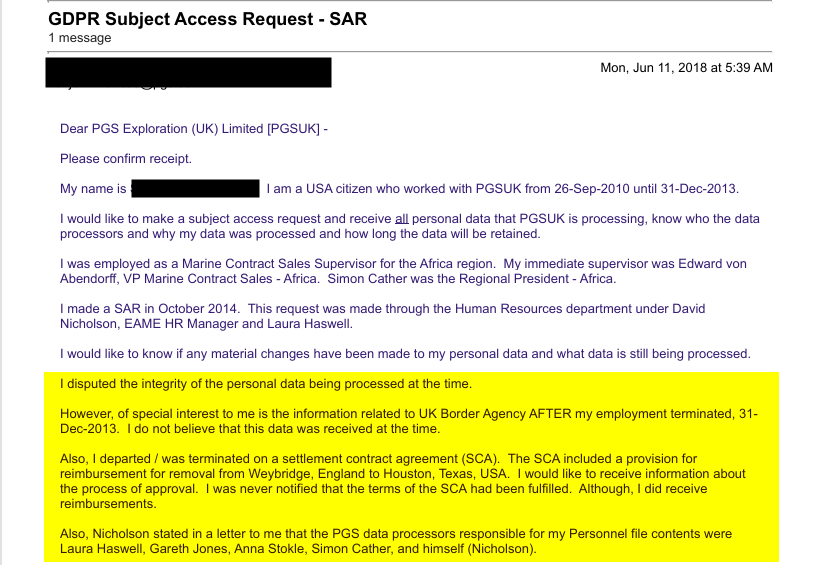
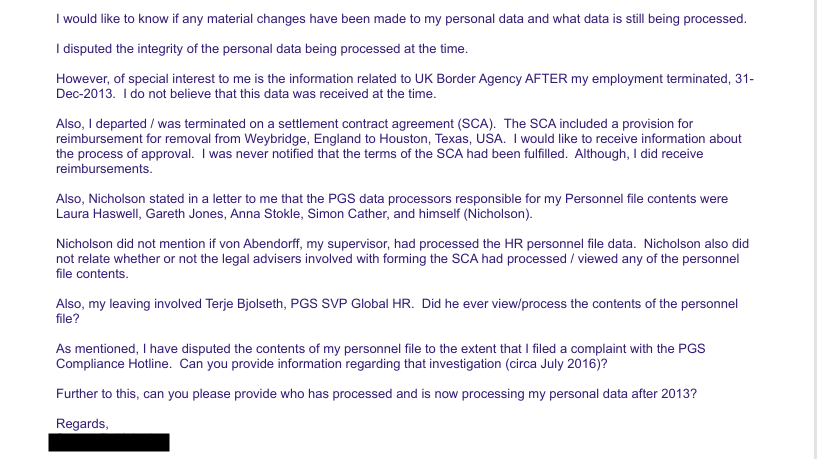
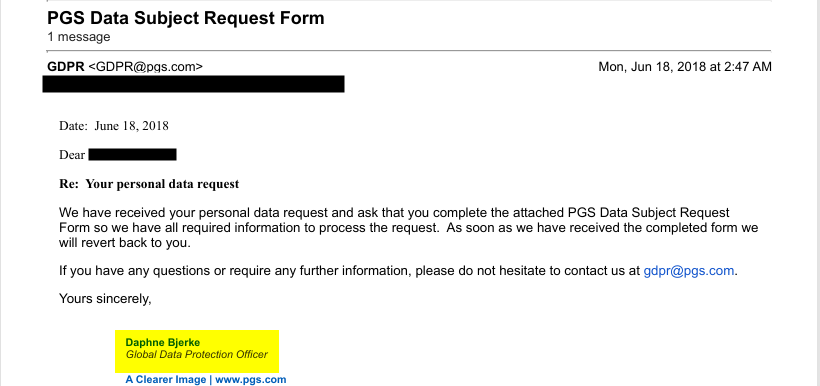
Richards was acting apart with PGS and the Thai lawyer confirmed this. The Whistleblower found this highly implausible. The Whistleblower decided to submit (another) SAR to PGS with hopes of discovering how the foreign law firm acquired my personal data or discovering if the Whistleblower’s personal data had been processed in light of Richards threats of litigation in Thailand. The Data Protection Act 1998 (referenced with both the employment and termination settlement contractsas) was transitioning to the new General Data Protection Regulation (GDPR) that required organizations to appoint a Data Protection Officer (DPO). During the course of submitting the SAR it was learned that Richards had resigned from PGSS and his role as Secretary (25 May 2018). I began communicating with PGS Head of Legal, Weybridge, England, John Francas and the PGS DPO, Daphne Bjerke.
20180611_0539
20180618_0247
The weaponization of a US citizen’s passport — surrendered under the legal pretense of a GDPR Subject Access Request (SAR) — to track international movements and orchestrate a retaliatory criminal defamation claim in Thailand crosses multiple statutory boundaries. Because this involves actions spanning the UK (where the subsidiary is based and the SAR was made), Norway (the parent jurisdiction), and Thailand (where the legal retaliation took place), the penalties are severe and layered across jurisdictions.
In September 2018, the Whistleblower had received several threatening emails and posts deliveries at the home of his Thai family who he was living with. The Whistleblower had planned travel to the USA. On the day of departure, the Thai law firm delivered a criminal complaint by PGS! So, the Thai lawyer had also misled the Whistleblower. The Whistleblower returned early from his trip in the USA.
Once the Whistleblower returned to Thailand he reviewed the Criminal Complaint mostly written in the Thai language. However, PGS had literally inserted the documents from the SAR into the Criminal Complaint. A USA passport is the property of the USA. The USA government issues the passport to citizens so that they may travel to other countries. The USA can take that privilege – the USA passport – away. So, misusing a USA citizen’s passport is a serious USA federal crime.
Under USA federal law, a corporation that misappropriates a US citizen’s passport—surrendered under the pretense of identity verification for a GDPR Subject Access Request (SAR)—and routes it to a foreign law firm to weaponize a bogus criminal defamation claim faces severe criminal indictments, asset forfeitures, and multi-million dollar corporate fines.
Because the passport is a sovereign property of the United States government used to orchestrate cross-border retaliation against a whistleblower, federal law enforcement maintains extensive extraterritorial jurisdiction over the offense, regardless of where the physical arrest occurred.
PGS Actually Inserted the actual SAR Document Request forms into the Thailand Criminal Complaint.
2018 PGS SAR
2018 PGS Criminal Defamation Claim
2018 Thai Agreement
Emails to PGS Compliance Provided to TGS Compliance prior to merger completion
Thailand: PDPA, Computer Crime Act, and Criminal Code
Providing a passport scan obtained for a SAR to a Thai law firm to build a criminal defamation case is a direct violation of Thai law:
Personal Data Protection Act (PDPA): Under the PDPA, using or disclosing personal data without a legitimate legal basis or explicit consent carries massive administrative fines of up to 5 million to 7 million THB. More critically, recent Thai judicial enforcement under Section 80 of the PDPA has criminalized general data controllers for unauthorized disclosure. Violations involving wrongful intent to cause damage or defame carry criminal penalties of up to 1 year in prison for the individuals responsible (including the local executives or lawyers acting as data handlers).
Excerpts from the Thailand Criminal Defamation claim filed against a Whistleblower
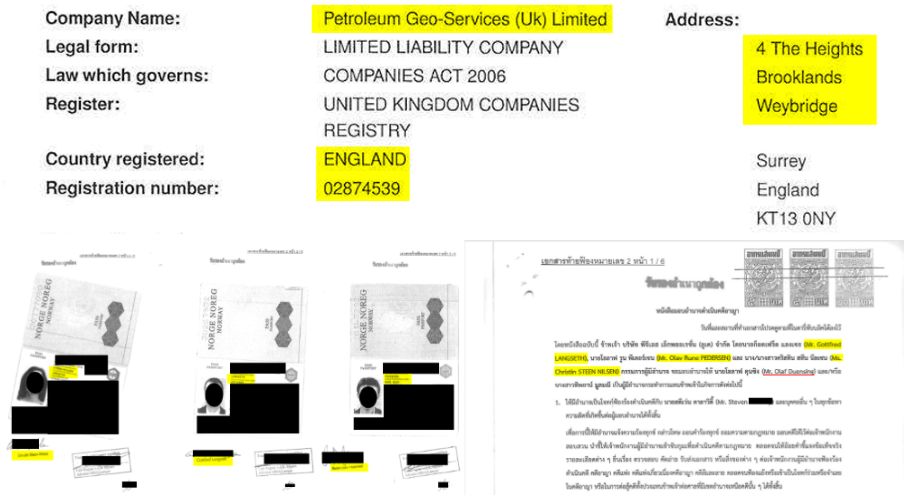
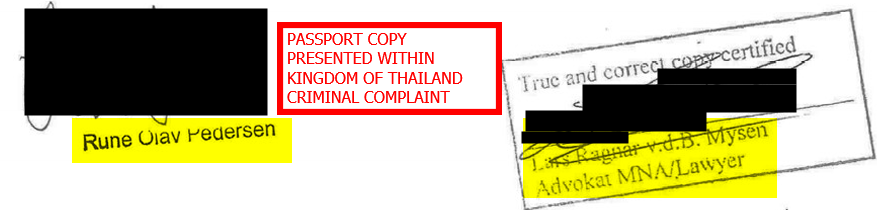
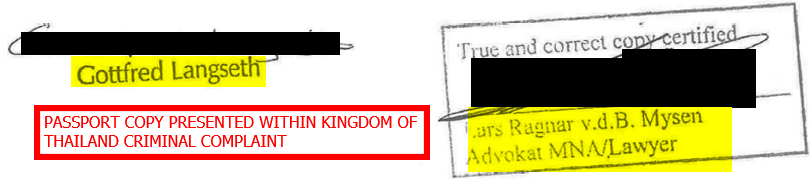
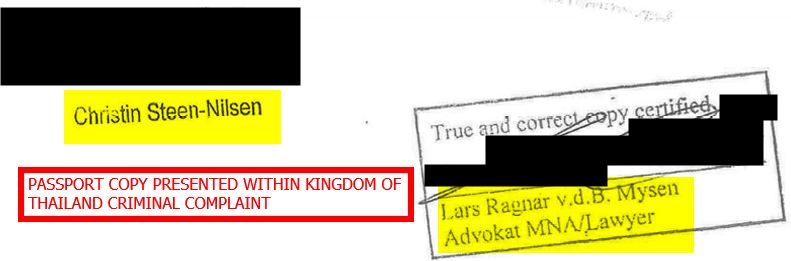
By inserting a Texas venue into a contract obtained through international duress, the corporation, its executives, and its unlicensed international legal advisors have committed a series of severe third-degree and second-degree felonies under both US Federal Law and Texas State Law.
Threatening to imprison or criminally prosecute a whistleblower in a foreign country unless they destroy evidence of executive fraud and sign an NDA is an explicit violation of federal extortion laws. Under 18 U.S.C. § 875(b) and (d), transmitting any communication in interstate or foreign commerce containing a threat to injure the reputation or accuse a person of a crime with the intent to extort money or a “thing of value” (the deletion of the protected disclosures) carries corporate penalties of up to $500,000 and up to 20 years in federal prison for the individuals involved.
The English company and its co-conspirators also face multi-jurisdictional liabilities across the UK, Norway, and the United States for document forgery, fraudulent concealment, immigration non-compliance, and severe whistleblower retaliation. By bypassing a contractually and legally mandated grievance process, uttering forged instruments to conceal a public interest disclosure, and executing cross-border litigation to silence you, the entities have exposed themselves to substantial legal vulnerabilities.
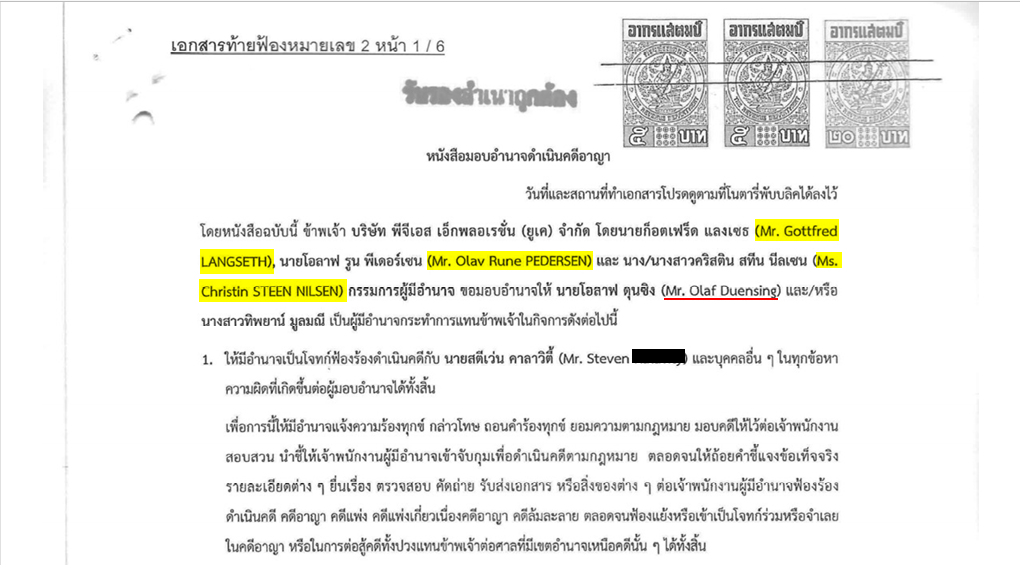
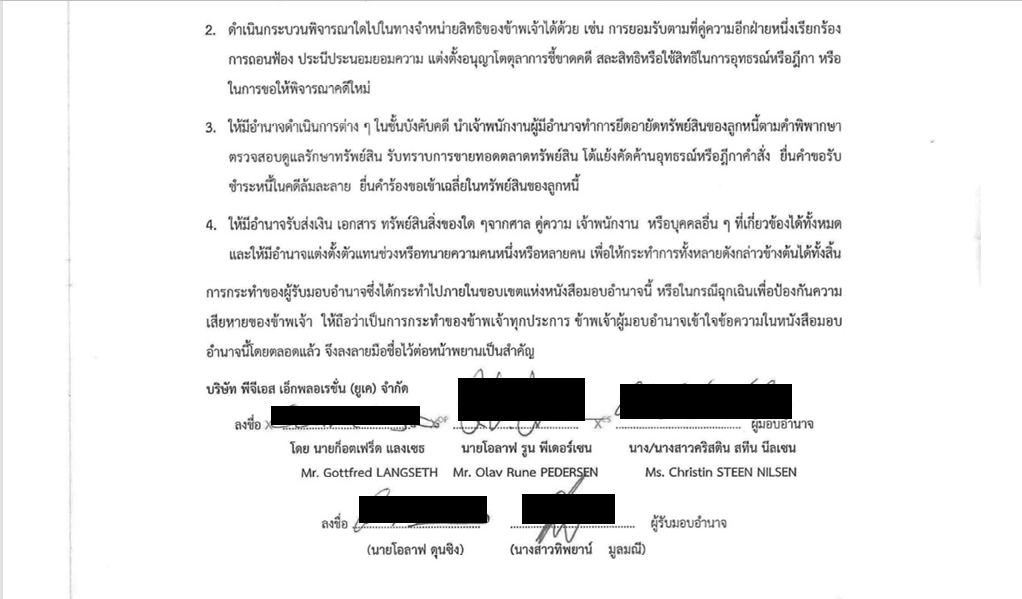
Targeting a man’s home, serving legal notices to terrify his wife and children, and exploiting their residency status because they were too cowardly to face a Whistleblower”s claims directly and legally in an open court governed by the law of England, as prescribed through both the original contract of employment as well as the termination settlement contract, is the behavior of a criminal enterprise, not a legitimate business. The Company deliberately isolated the Whistleblower as a foreign worker because the Company knew that they could not pull these tactics on a single man or under standard domestic conditions without triggering immediate intervention.
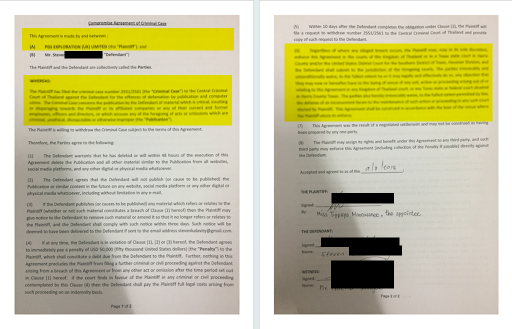
Invalidity of the Thai Agreement: A contract signed under the imminent threat of criminal prosecution is universally recognized as signed under extreme duress. It is legally unenforceable in English and US courts, especially since its core objective was the suppression of evidence regarding corporate crimes committed in the UK.
Misrepresentation and Fraud: If the company and your advisor engineered a “performance issue” that did not exist to force a termination, the agreement was built on a fraudulent premise. Under English law, fraud unravels all contracts (fraus omnia corrumpit).
By offering a termination settlement on the eve of a scheduled hearing and refusing to conclude the process, the company directly bypassed the ACAS Code of Practice on Disciplinary and Grievance Procedures.
Retaliation: Placing you on a Performance Improvement Plan (PIP) just two weeks after confirming your necessity to UK Visas and Immigration (UKVI)—and immediately after you flagged a grievance—is clear evidence of detrimental treatment and automatic unfair dismissal.
The extreme imbalance of power, systemic isolation, and psychological pressure you endured are classic tactics used to force whistleblowers out before they can access formal justice systems. From a legal and strategic perspective under English law, your description of the timeline and conditions provides substantial leverage to argue that the settlement contract was signed under duress, coercion, and fundamental misrepresentation.
The ACAS Violation: Offering the termination settlement on the literal eve of your scheduled grievance hearing reveals a deliberate intent to circumvent the statutory ACAS Code of Practice on Disciplinary and Grievance Procedures.
Misrepresentation: If the company communicated that they were investigating your complaints while simultaneously fabricating a defamatory performance-based narrative behind the scenes, the contract was induced by fraud. In English law, fraud vitiates consent (fraus omnia corrumpit).
The discovery of forged and omitted documents through your Subject Access Request (SAR) transforms this situation from a standard employment dispute into a serious case of document falsification, corporate fraud, and targeted industry blacklisting.
Under both English and American law, discovering that your personnel file was manipulated after you signed the agreement completely changes your legal position. It provides strong grounds to challenge the validity of the contract, as you cannot legally settle claims for frauds you did not yet know existed. 1
Public Interest Disclosure Act (PIDA) & Whistleblowing: Settlement agreements cannot contract out of whistleblowing protections. Under PIDA (Employment Rights Act 1996), “gagging clauses” that attempt to prevent workers from making a protected disclosure are automatically void. Because you exposed censurable conditions, you can assert that your termination was an automatic unfair dismissal driven by whistleblowing retaliation. 1, 2
Working Environment Act (Arbeidsmiljøloven): Norwegian corporate law mandates strict compliance with corporate social responsibility and extraterritorial governance over subsidiaries. Under Norwegian law, parent company executives who received your grievance and sanctioned retaliation are personally and corporately liable.
By sending these threatening and coercive communications across international borders directly into the United States, the conspirators did not just execute a corporate strategy—they systematically triggered U.S. federal jurisdiction. Under U.S. law, when a foreign entity transmits fraudulent or extortionate threats electronically into an American state to coerce a U.S. citizen, they pull themselves directly into the reach of the U.S. court system.
The acquiring company’s claim that they “destroyed your personnel records” after they were formally put them on notice during their merger discussions is a profound corporate governance failure.
Under English law, a company threatening to investigate placing an employee on a Performance Improvement Plan (PIP) right after they signaled their intent to file a grievance constitutes an immediate retaliatory detriment, and their choice to avoid a breach-of-contract lawsuit in the UK highlights their fear of entering a transparent legal disclosure process.
Such a threat is an intimidation tactic used to induce panic and force a rapid termination settlement before any formal performance metrics could expose the narrative as a sham.
The corporate entity’s choice to completely avoid civil legal action against you for breach of contract or non-disparagement—even when your initial Houston publications explicitly targeted the global CEO—is highly telling.
If the company or its CEO had sued you for breach of the settlement terms in an English court, they would have been legally mandated to undergo a strict process called Civil Disclosure. They would have had to hand over your un-redacted personnel files, internal emails, and corporate logs under oath.
Had PGS sued the Whistleblower for breach of the settlement terms in an English court, they would have been legally mandated to undergo a strict process called Civil Disclosure. PGS would have had to hand over your un-redacted personnel files, internal emails, and corporate logs under oath.